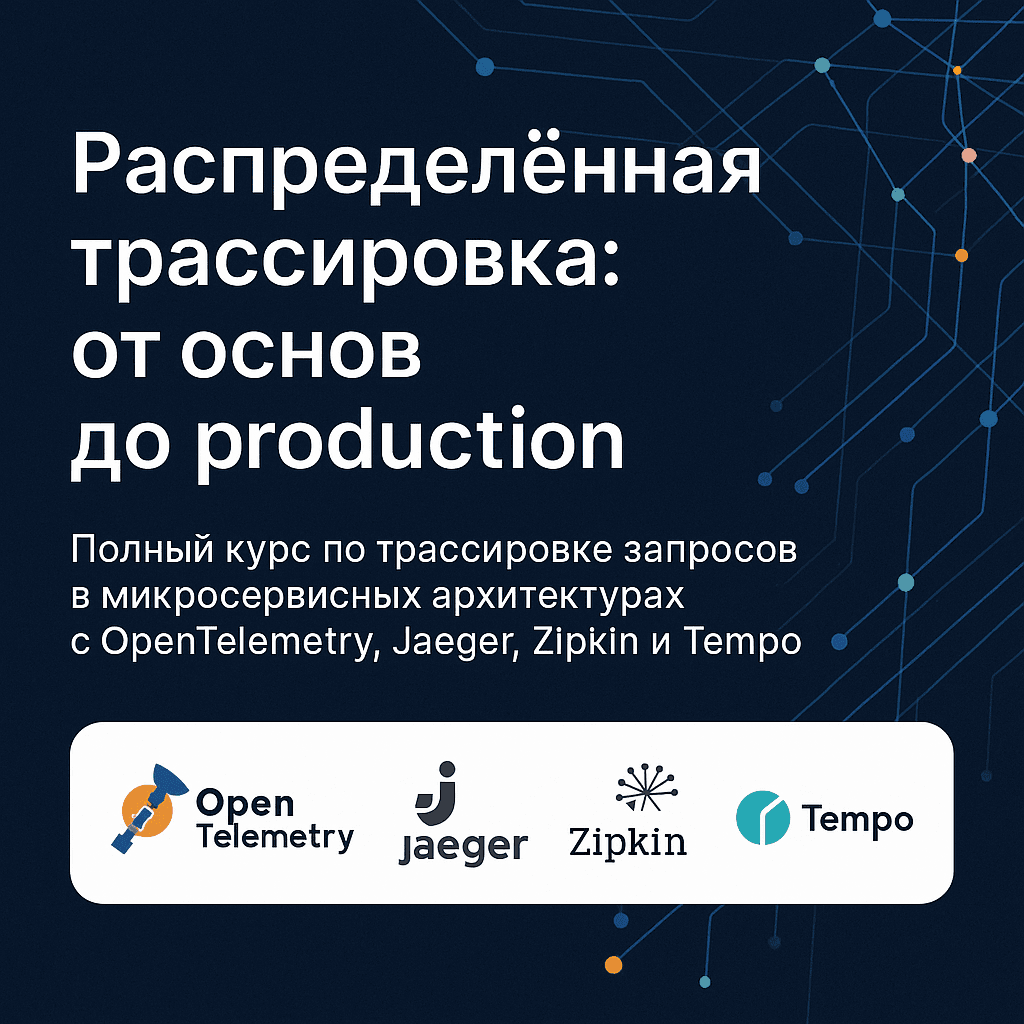
Распределенная трассировка: от основ до production
Научитесь отлаживать микросервисы с помощью distributed tracing: от базовых концепций до production-ready setup с примерами на Node.js, Python и Go
What you'll learn
Полный курс по трассировке запросов в микросервисных архитектурах с OpenTelemetry, Jaeger, Zipkin и Tempo
From theory to production in one course
Start with simple examples and finish with production-ready setup including OpenTelemetry Collector, tail-based sampling, and correlation with logs and metrics
Code in 3 languages: Node.js, Python, Go
All examples available in three popular languages with auto-instrumentation for Express, FastAPI, and Gorilla Mux
Practice > Theory
Every lesson includes working code. No abstract concepts without real examples and Docker Compose environment
Real debugging cases
Learn to find N+1 queries, slow external APIs, retry logic issues, and other typical microservices problems
Queue-based and async tracing
Complete guide to Kafka and RabbitMQ with working examples in 3 languages. Manual context propagation, Dead Letter Queues, retry patterns — topics other courses skip
Visual learning with Mermaid diagrams
Sequence diagrams for trace flows, architecture diagrams for systems, gantt charts for timeline — visualizations make complex concepts easy to understand
gRPC tracing: from proto to streaming
Complete gRPC guide with unary, server streaming, client streaming and bidirectional streaming examples. Metadata propagation, interceptors, debugging — everything for production
Service Mesh: zero-code tracing
Automatic tracing with Istio/Envoy via sidecar pattern. Get distributed traces from legacy apps WITHOUT code changes. Kubernetes + Jaeger integration
Testimonials
alumniNo reviews yet — be the first
Leave a reviewWhat's inside
17+ hours of practical content with step-by-step instructions
Ready-to-run application examples in Node.js, Python, and Go with Docker Compose
Complete stack setup: Jaeger, Zipkin, Tempo, OpenTelemetry Collector
Production best practices: sampling, performance tuning, security
Integration with Prometheus, Grafana, Loki for metrics and logs correlation
Hands-on assignments after each lesson
Complete Kafka and RabbitMQ tracing guide with working examples
Mermaid diagrams for trace flows and architecture visualization
Async processing patterns: manual context propagation, DLQ debugging, retry patterns
gRPC tracing: unary, server/client/bidirectional streaming with examples in 3 languages
Service Mesh (Istio): automatic tracing without application code changes
Kubernetes integration: sidecar pattern, Envoy proxy, Jaeger operator
6 production debugging scenarios: retry storms, N+1 queries, cascading failures and other real-world issues
W3C Baggage API for business context propagation: feature flags, tenant ID, user segments
Prerequisites
Microservices experience
requiredUnderstanding of microservices architecture, REST API, async queues
Basic programming skills
requiredAbility to read code in Node.js, Python, or Go. Examples available in all three languages
Docker familiarity
requiredBasic understanding of Docker and Docker Compose to run examples
Production debugging experience
Preferably have experience investigating incidents in distributed systems
Course curriculum
Почему 5 секунд в браузере превращаются в 8 часов поиска проблемы?
15 минут
Первый трейс за 15 минут
25 минут
Обзор инструментов: Jaeger, Zipkin, Tempo, OpenTelemetry
30 минут
Как устроен трейс: Traces, Spans, Context
30 минут
Первый проект: инструментация простого приложения
60 минут
Трассировка цепочки микросервисов
70 минут
Context Propagation, W3C Trace Context и Baggage API
70 минут
Queue-Based Tracing: Kafka, RabbitMQ и async processing
85 минут
gRPC Distributed Tracing: от proto до production
70 минут
Стратегии сэмплирования: от простого к adaptive
60 минут
Корреляция трейсов, логов и метрик
50 минут
OpenTelemetry Collector: архитектура и настройка
80 минут
Service Mesh Tracing: автоматическая трассировка с Istio
75 минут
Tail-based sampling для production
60 минут
Performance Tuning: минимизация overhead
50 минут
Security & Privacy: PII redaction и авторизация
50 минут
Troubleshooting и best practices
40 минут
Production Debugging: от алерта до root cause за 5 минут
60 минут
FAQ
Do I need to know all three languages (Node.js, Python, Go)?
No! All examples are available in three languages, but knowing just one is enough. Tracing concepts are the same across all platforms.
Can I apply this knowledge to other languages (Java, C#, PHP)?
Yes! OpenTelemetry supports all popular languages. Tracing principles, context propagation, and collector setup are the same everywhere.
What if I use a different backend (not Jaeger)?
The course covers Jaeger, Zipkin, and Tempo. OpenTelemetry works with any OTLP-compatible backend (Datadog, New Relic, Honeycomb, etc.).
How long does it take to complete the course?
With active practice — 2-3 weeks (1-2 hours per day). You can go at your own pace.
Is there support and help during the course?
Yes! You can ask questions through the feedback form. I usually respond within 24 hours.
Is the course suitable for beginners?
If you're familiar with microservices and can read code — yes. The course starts with basics but quickly moves to practice.
Related Materials
These materials complement the course but are not part of it. Study at your own pace.
Google Dapper Paper
Original Google paper on distributed tracing (2010) — foundation of the industry
OpenTelemetry Documentation
Official OpenTelemetry documentation — always up-to-date information
Jaeger Documentation
Complete documentation on Jaeger installation, configuration, and usage
W3C Trace Context Specification
W3C standard for trace context propagation between services