Checkout made seven synchronous HTTP calls. Auth, catalog, promo, inventory, order, payment, email. If one service thinks longer than five seconds, the cart dies with it. Users write. The CEO asks who is to blame.
That is request-response after you keep bolting features onto it. Stripe and Airbnb wrote the same story with bigger numbers.
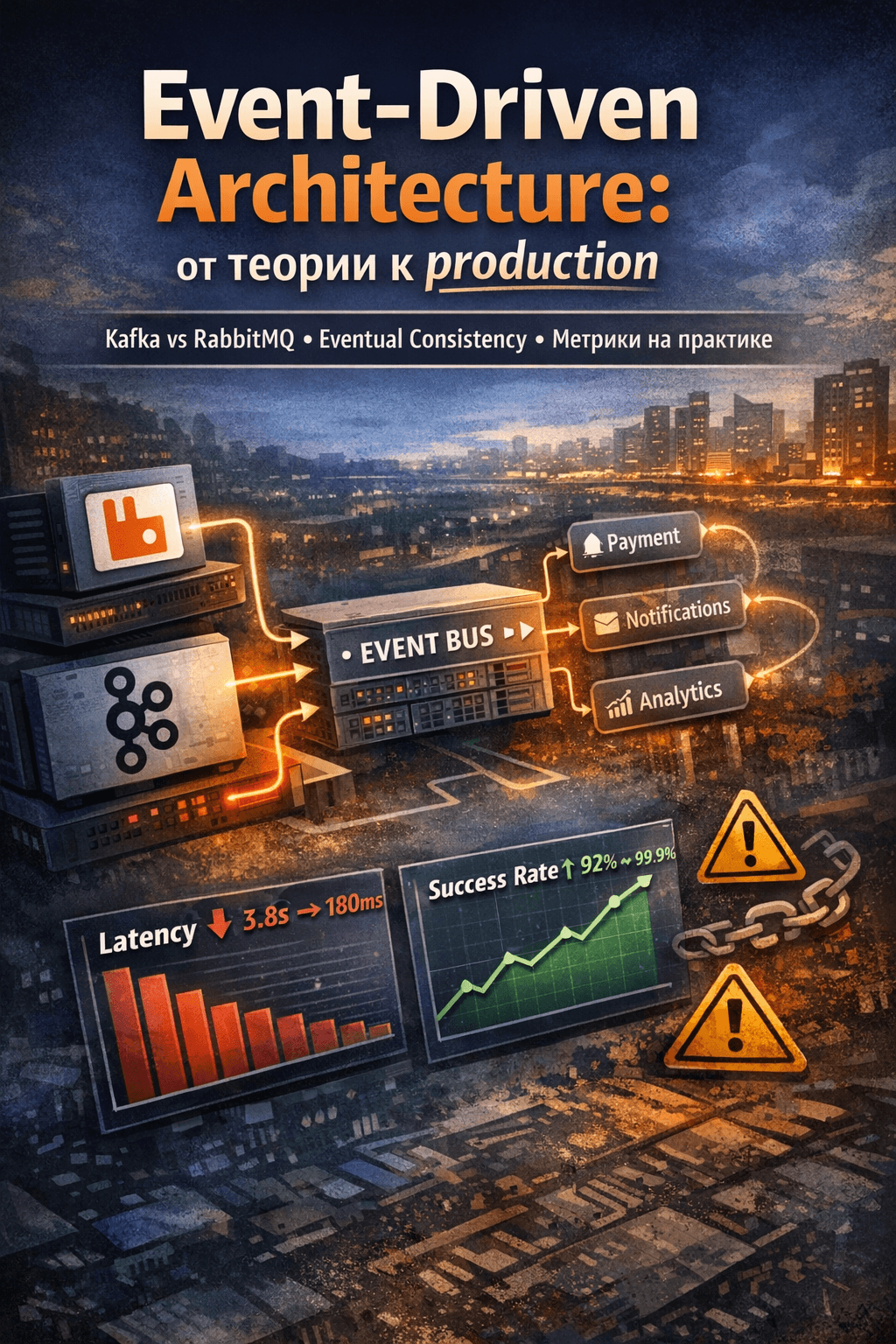
Once email, analytics, and recommendations left the request, P99 checkout dropped from 2.3 seconds to 180 ms, availability from 99.5% to 99.95%. Night alerts thinned out too. Not Kafka magic. A split: inventory and validation stay on the critical path, the rest go to a queue.
Events are not a broker
Event-Driven Architecture is how services talk, not a brand choice between Kafka and RabbitMQ.
Two models.
Request-response. A phone call:
You: "Hello, what's the weather?"
Friend: "Wait... (searching for info) ...+15°C"
You: (waiting all this time with phone to your ear)
Event. A news feed:
You: (publish event "Want to know weather")
Weather service: (sees event and publishes "+15°C" to feed)
You: (will see the answer when you're ready)
In the first case you wait with the phone at your ear. In the second you keep living.
Seven calls for one checkout
An e-commerce team adds features to order creation. Each "small extra" joins the chain:
What should happen at checkout:
- Check user in Auth Service (50ms)
- Validate products in Catalog Service (80ms)
- Check promo code in Discount Service (120ms)
- Reserve inventory in Inventory Service (200ms)
- Create order in Order Service (100ms)
- Charge payment in Payment Service (300ms)
- Send email via Notification Service (150ms)
Synchronous implementation:
# ❌ Potential trap: dependency chain
from fastapi import FastAPI, HTTPException
import httpx

app = FastAPI()

@app.post("/checkout")
async def checkout(order: CheckoutRequest):
    async with httpx.AsyncClient(timeout=5.0) as client:
        # 1. Check user
        user = await client.get(f"http://auth-service/users/{order.user_id}")
        if user.status_code != 200:
            raise HTTPException(401, "User not found")

        # 2. Validate products
        catalog = await client.post(
            "http://catalog-service/validate",
            json={"items": order.items}
        )
        if catalog.status_code != 200:
            raise HTTPException(400, "Invalid items")

        # 3. Check promo code
        discount = await client.post(
            "http://discount-service/validate",
            json={"code": order.promo_code}
        )

        # 4. Reserve inventory
        inventory = await client.post(
            "http://inventory-service/reserve",
            json={"items": order.items}
        )
        if inventory.status_code != 200:
            raise HTTPException(400, "Out of stock")

        # 5. Create order
        order_response = await client.post(
            "http://order-service/orders",
            json=order.dict()
        )

        # 6. Charge payment
        payment = await client.post(
            "http://payment-service/charge",
            json={"amount": order.total, "user_id": order.user_id}
        )
        if payment.status_code != 200:
            # Oh no! Order created but payment failed!
            # Need rollback... but how?
            raise HTTPException(500, "Payment failed")

        # 7. Send email
        await client.post(
            "http://notification-service/send",
            json={"email": user.json()["email"], "order_id": order_response.json()["id"]}
        )

        return {"order_id": order_response.json()["id"]}
Common problems with this approach:
Problem #1: Latency accumulates
Best case: 50 + 80 + 120 + 200 + 100 + 300 + 150 = 1000ms
Worst case (P99): 200 + 300 + 500 + 800 + 400 + 1200 + 600 = 4000ms (4 seconds!)
Problem #2: Cascading failures
Notification Service down (DNS timeout 30s)
→ Checkout waits 30 seconds
→ Users see spinning loader
→ Users hit F5
→ Duplicate orders created
→ Chaos
Problem #3: Partial rollback impossible
Scenario:
1. Order created ✅
2. Inventory reserved ✅
3. Payment Service failed ❌

Result: Product reserved but not paid.
Solution: ??? (manual cleanup in admin panel)
Typical metrics of such a system under load:
- P99 latency checkout: 3.8+ seconds
- Success rate: 92% (8% fail due to timeouts)
- Duplicate orders: ~5% (users hit F5 due to slow loading)
- Unhappy customers: growing exponentially
Synchronous HTTP calls between microservices are like a chain of weak links. One link breaks → entire chain fails. Latency accumulates, failures cascade, rollback becomes a nightmare.
Checkout through an event
Split checkout into two phases.
Phase 1 (synchronous): Critical business logic
- Data validation
- Inventory reservation (must succeed now)
- Create order in
PENDINGstatus
Phase 2 (asynchronous): Everything else via events
- Payment processing
- Email notifications
- Analytics
- Recommendation updates
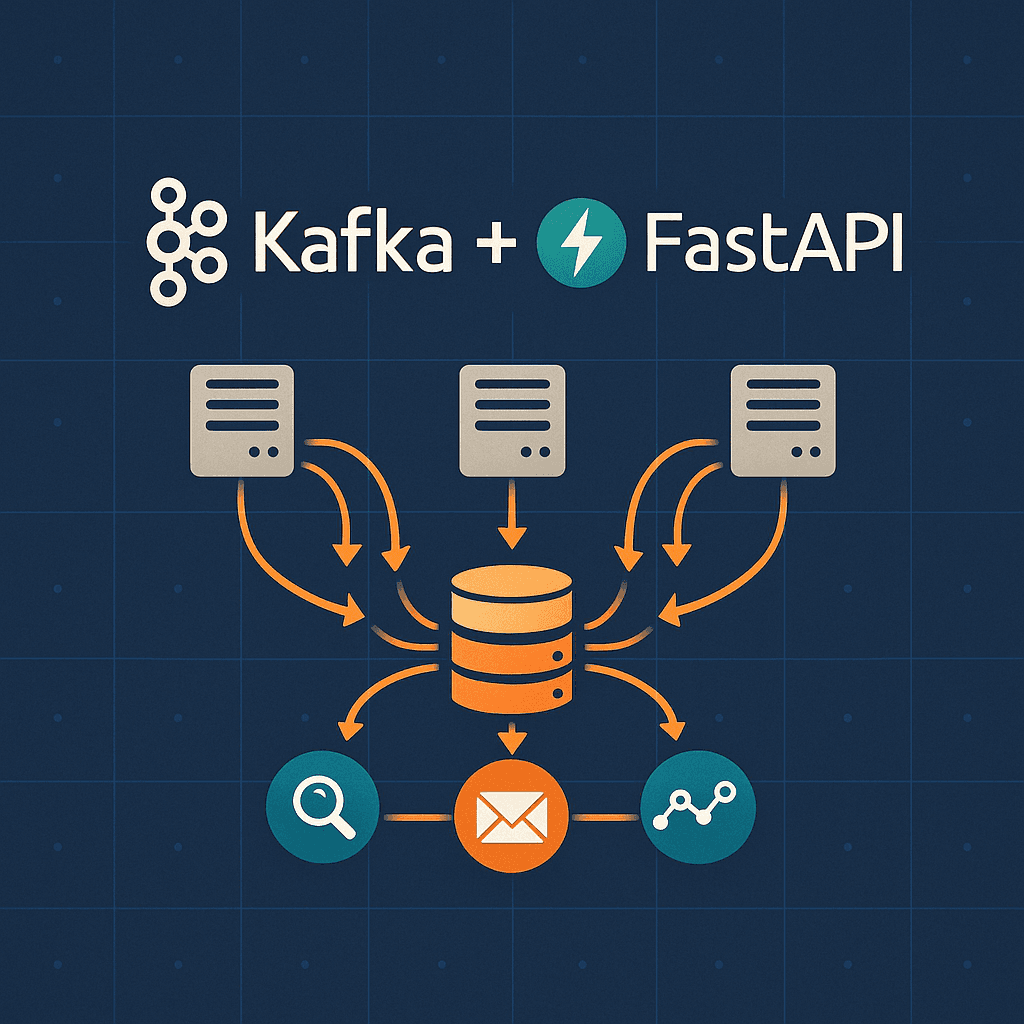
New architecture:
# ✅ Event-driven approach (using Kafka as broker)
from fastapi import FastAPI
from kafka import KafkaProducer
import json

app = FastAPI()

# Kafka producer (could be Redis Streams, RabbitMQ, etc.)
producer = KafkaProducer(
    bootstrap_servers='kafka:9092',
    value_serializer=lambda v: json.dumps(v).encode('utf-8')
)

@app.post("/checkout")
async def checkout(order: CheckoutRequest):
    # SYNCHRONOUS (critical for UX)
    # 1. Quick validation
    validate_order_data(order)  # 5ms, in-memory

    # 2. Inventory reservation (only external call!)
    async with httpx.AsyncClient(timeout=2.0) as client:
        inventory = await client.post(
            "http://inventory-service/reserve",
            json={"items": order.items}
        )
        if inventory.status_code != 200:
            raise HTTPException(400, "Out of stock")

    # 3. Create order in PENDING status
    order_id = await db.create_order(order, status="PENDING")

    # ASYNCHRONOUS (via events)
    # Publish the event. The rest is not our problem.
    producer.send('orders.created', {
        'order_id': order_id,
        'user_id': order.user_id,
        'items': order.items,
        'total': order.total,
        'timestamp': datetime.utcnow().isoformat()
    })

    # Return result instantly!
    return {
        "order_id": order_id,
        "status": "pending",
        "message": "Order created, payment processing"
    }
Consumers (separate services listen to events):
# Payment Service (listens to "orders.created" events)
from kafka import KafkaConsumer
import json

consumer = KafkaConsumer(
    'orders.created',
    bootstrap_servers='kafka:9092',
    value_deserializer=lambda m: json.loads(m.decode('utf-8')),
    group_id='payment-service'
)

for message in consumer:
    order = message.value

    try:
        # Charge payment
        payment = await charge_payment(order['user_id'], order['total'])

        # Publish success event
        producer.send('payments.completed', {
            'order_id': order['order_id'],
            'payment_id': payment.id,
            'status': 'success'
        })

    except PaymentError as e:
        # Publish failure event
        producer.send('payments.failed', {
            'order_id': order['order_id'],
            'reason': str(e)
        })
# Notification Service (listens to "payments.completed" events)
consumer = KafkaConsumer(
'payments.completed',
bootstrap_servers='kafka:9092',
group_id='notification-service'
)
for message in consumer:
payment = message.value
# Send email. Even if it fails, checkout already passed.
await send_email(
user_id=payment['user_id'],
template='order_confirmation',
data={'order_id': payment['order_id']}
)Typical results after implementation (based on industry migration experiences):
Infrastructure savings: In typical cases, instance count decreases by 20-40% (due to lower load and better scaling). This is ~$500-1000/month for medium-sized projects.
Main point: UX improves (fast checkout), incident count decreases, team gets fewer night alerts.
When events belong
A synchronous call is simpler while the chain is short and every step is needed before the response.
When yes (three or more):
1. Asynchronous operations present?
Examples:
- Sending email/SMS
- Report generation
- Image/video processing
- ML inference
- Analytics
2. Need fault tolerance?
Scenario: Email service is down
❌ Synchronous: Checkout fails for everyone
✅ Event-driven: Checkout works, emails sent later
3. Microservice architecture?
5+ services → high risk of cascading failures
Event-driven reduces coupling between services
4. High load?
> 1000 req/s → synchronous calls slow down
Event bus acts as buffer, smooths load spikes
5. Need audit trail / Event Sourcing?
Requirement: restore system state at any point in time
Event log = complete history of all changes
6. Different processing speeds?
Fast: API endpoint responds in 50ms
Slow: Email generation takes 2 seconds

Event-driven allows not waiting for slow operations
When no:
❌ Simple CRUD system
Todo-app, blog, simple admin panel
→ Synchronous REST API is simpler and clearer
❌ Need immediate consistency
Bank transaction: money must be debited NOW
→ Eventual consistency doesn't fit
❌ Team not ready
Debugging event-driven systems is harder
Need:
- Distributed tracing
- Event monitoring
- Understanding of eventual consistency
❌ One monolith, 3 developers
Event bus overhead not justified
→ Start with modular monolith
If the operation must finish before the user gets a response, keep it synchronous. Everything else is a candidate for an event. Netflix, Uber, Spotify work this way.
Patterns
One event in Kafka is not an architecture. The trade-off lives in what the event carries.
Event Notification
Idea: Event contains minimal data, only ID and event type.
# Publisher
producer.send('user.registered', {
    'event_id': 'evt_123',
    'user_id': 'usr_456',
    'timestamp': '2025-12-26T10:00:00Z'
})

# Consumer (must fetch data itself)
@app.on_event('user.registered')
async def on_user_registered(event):
    # Make HTTP request for data
    user = await user_service.get_user(event['user_id'])
    await send_welcome_email(user.email)
Pros:
- ✅ Small message size
- ✅ No data duplication
Cons:
- ❌ Consumer depends on source service (coupling)
- ❌ Additional HTTP request (latency)
When to use: Data changes frequently and freshness is critical.
Event-Carried State Transfer
Idea: Event contains ALL necessary data for processing.
# Publisher
producer.send('user.registered', {
    'event_id': 'evt_123',
    'user_id': 'usr_456',
    'email': 'user@example.com',
    'name': 'John Doe',
    'created_at': '2025-12-26T10:00:00Z',
    'subscription_plan': 'premium'
})

# Consumer (no HTTP requests!)
@app.on_event('user.registered')
async def on_user_registered(event):
    # Everything already in event
    await send_welcome_email(
        email=event['email'],
        name=event['name']
    )
Pros:
- ✅ Consumer independent from source service
- ✅ No additional HTTP requests
- ✅ Can process event even if source service is down
Cons:
- ❌ Larger message size (more traffic)
- ❌ Data duplication (risk of inconsistency)
When to use: Consumers must work independently, data changes rarely.
Recommended approach for most cases: Event-Carried State Transfer in 80% of scenarios. Reduces coupling, simplifies debugging (all data visible in event). Used in Amazon, Zalando, Shopify architectures.
Event Sourcing
Idea: System state = sum of all events. Don't store current state in DB, only store events.
# Traditional approach (CRUD)
class Order:
    id: int
    status: str  # "pending" | "paid" | "shipped" | "completed"
    total: float

# When changed, overwrite row in DB
await db.execute("UPDATE orders SET status = 'paid' WHERE id = 123")
# Event Sourcing approach
# Events (append-only log)
events = [
{'type': 'OrderCreated', 'order_id': 123, 'total': 1500, 'timestamp': '2025-12-26T10:00:00Z'},
{'type': 'PaymentReceived', 'order_id': 123, 'amount': 1500, 'timestamp': '2025-12-26T10:05:00Z'},
{'type': 'OrderShipped', 'order_id': 123, 'tracking': 'TR123', 'timestamp': '2025-12-26T12:00:00Z'},
]
# State = replay all events
def get_order_state(order_id):
events = event_store.get_events(order_id)
state = {}
for event in events:
if event['type'] == 'OrderCreated':
state['status'] = 'pending'
state['total'] = event['total']
elif event['type'] == 'PaymentReceived':
state['status'] = 'paid'
elif event['type'] == 'OrderShipped':
state['status'] = 'shipped'
return statePros:
- ✅ Complete audit trail (can restore state at any point in time)
- ✅ Debugging easier (all changes visible)
- ✅ Time travel (rollback to past state)
Cons:
- ❌ Complexity (need event store, snapshots, projections)
- ❌ Performance (replaying events can be slow)
- ❌ Can't delete data (GDPR problem)
When to use: Financial systems, audit critical, complex business logic.
CQRS
Idea: Separate write (Command) and read (Query) into different models.
┌─────────────┐
│   Client    │
└──────┬──────┘
       │
       ├─ Command (write) ─────────► Command Handler ─► Event Store
       │                                                       │
       └─ Query (read) ────────────► Read Model ◄─────────────┘
                                     (materialized view)
Example:
# Command side (write)
class CreateOrderCommand:
    user_id: int
    items: List[Item]

@app.post("/orders")
async def create_order(cmd: CreateOrderCommand):
    # Validation
    # Event creation
    events = [
        OrderCreatedEvent(user_id=cmd.user_id, items=cmd.items),
        InventoryReservedEvent(items=cmd.items)
    ]
    # Save to event store
    await event_store.append(events)
    return {"order_id": events[0].order_id}

# Query side (read)
@app.get("/orders/{order_id}")
async def get_order(order_id: int):
    # Read from materialized view (fast!)
    return await read_db.get_order(order_id)

# Projector (updates read model from events)
@consumer.on('OrderCreatedEvent')
async def project_order(event):
    await read_db.insert_order({
        'id': event.order_id,
        'user_id': event.user_id,
        'status': 'pending',
        'created_at': event.timestamp
    })
Pros:
- ✅ Read and write optimized independently
- ✅ Complex queries don't affect write performance
- ✅ Can scale read and write separately
Cons:
- ❌ Complexity (two data models)
- ❌ Eventual consistency (read model may lag)
When to use: Read-heavy systems, complex analytical queries.
Kafka, RabbitMQ, Redis Streams
The bus is not a taste. It is load, replay, and who will fix it at 3 a.m.
Kafka
When to use:
- Throughput > 100k messages/sec
- Need persistence (event replay)
- Event sourcing / stream processing
- Large team (someone to maintain)
Pros:
- ✅ High throughput (millions msg/sec)
- ✅ Persistence (events stored days/months)
- ✅ Replay (can re-read old events)
- ✅ Partitioning (horizontal scaling)
Cons:
- ❌ Complex setup (ZooKeeper, brokers, replication)
- ❌ Overkill for small systems
- ❌ Higher latency than RabbitMQ (optimized for throughput)
What is ZooKeeper? Distributed coordination for Kafka metadata: which brokers are alive, which topics exist, who leads a partition. The cluster address book. Where is the leader of partition X? Who is in consumer group Y?
Good news: Starting from Kafka 3.3+ (2022), KRaft mode (Kafka Raft) appeared, which doesn't require ZooKeeper. Kafka manages its own metadata. This simplifies deployment and reduces moving parts. In production 2025, KRaft is recommended over ZooKeeper.
Example (Python + aiokafka):
from aiokafka import AIOKafkaProducer, AIOKafkaConsumer
import json

# Producer
producer = AIOKafkaProducer(
    bootstrap_servers='localhost:9092',
    value_serializer=lambda v: json.dumps(v).encode()
)
await producer.start()
await producer.send('orders.created', {'order_id': 123})

# Consumer
consumer = AIOKafkaConsumer(
    'orders.created',
    bootstrap_servers='localhost:9092',
    group_id='payment-service',
    value_deserializer=lambda m: json.loads(m.decode())
)
await consumer.start()
async for msg in consumer:
    print(f"Order: {msg.value}")
Docker Compose (KRaft mode, recommended in 2025):
services:
  kafka:
    image: confluentinc/cp-kafka:7.6.0
    ports:
      - "9092:9092"
    environment:
      # KRaft mode (without ZooKeeper)
      KAFKA_NODE_ID: 1
      KAFKA_PROCESS_ROLES: "broker,controller"
      KAFKA_CONTROLLER_QUORUM_VOTERS: "1@kafka:9093"
      KAFKA_LISTENERS: "PLAINTEXT://kafka:9092,CONTROLLER://kafka:9093"
      KAFKA_ADVERTISED_LISTENERS: "PLAINTEXT://localhost:9092"
      KAFKA_CONTROLLER_LISTENER_NAMES: "CONTROLLER"
      KAFKA_LISTENER_SECURITY_PROTOCOL_MAP: "CONTROLLER:PLAINTEXT,PLAINTEXT:PLAINTEXT"
      KAFKA_OFFSETS_TOPIC_REPLICATION_FACTOR: 1
      # Storage formatting (mandatory for KRaft)
      CLUSTER_ID: "MkU3OEVBNTcwNTJENDM2Qk"
Legacy variant with ZooKeeper (if compatibility needed)
services:
  kafka:
    image: confluentinc/cp-kafka:7.6.0
    ports:
      - "9092:9092"
    environment:
      KAFKA_BROKER_ID: 1
      KAFKA_ZOOKEEPER_CONNECT: zookeeper:2181
      KAFKA_ADVERTISED_LISTENERS: PLAINTEXT://kafka:9092
      KAFKA_OFFSETS_TOPIC_REPLICATION_FACTOR: 1

  zookeeper:
    image: confluentinc/cp-zookeeper:7.6.0
    environment:
      ZOOKEEPER_CLIENT_PORT: 2181
RabbitMQ
When to use:
- Need flexible routing (topic exchange, fanout, headers)
- Priority queues
- Small/medium loads (< 50k msg/sec)
- Quick start (easier to setup than Kafka)
Pros:
- ✅ Setup simplicity
- ✅ Flexible routing (exchange types)
- ✅ Monitoring UI (RabbitMQ Management)
- ✅ Low latency
Cons:
- ❌ Lower throughput than Kafka
- ❌ No persistence by default (can enable, but slower)
- ❌ Replay harder
Example (Python + aio-pika):
import aio_pika
import json

# Publisher
connection = await aio_pika.connect_robust("amqp://localhost/")
channel = await connection.channel()

await channel.default_exchange.publish(
    aio_pika.Message(
        body=json.dumps({'order_id': 123}).encode(),
        delivery_mode=aio_pika.DeliveryMode.PERSISTENT
    ),
    routing_key='orders.created'
)

# Consumer
queue = await channel.declare_queue('payment-service-queue', durable=True)
await queue.bind(exchange='events', routing_key='orders.created')

async with queue.iterator() as queue_iter:
    async for message in queue_iter:
        async with message.process():
            data = json.loads(message.body.decode())
            print(f"Order: {data}")
Redis Streams
When to use:
- Already using Redis
- Need low latency
- Simple use cases (pub/sub, task queue)
- Small/medium loads
Pros:
- ✅ Minimal overhead (Redis already there)
- ✅ Very low latency
- ✅ Simplicity (familiar Redis API)
- ✅ Consumer groups (like in Kafka)
Cons:
- ❌ In-memory (limited by RAM)
- ❌ No persistence guarantees
- ❌ Not for high loads
Example (Python + redis-py):
import redis.asyncio as redis
import json

r = await redis.from_url("redis://localhost")

# Producer
await r.xadd(
    'orders:created',
    {'data': json.dumps({'order_id': 123})}
)

# Consumer
consumer_group = 'payment-service'
await r.xgroup_create('orders:created', consumer_group, mkstream=True)

while True:
    messages = await r.xreadgroup(
        consumer_group,
        'worker-1',
        {'orders:created': '>'},
        count=10
    )
    for stream, msgs in messages:
        for msg_id, data in msgs:
            order = json.loads(data[b'data'])
            print(f"Order: {order}")
            await r.xack('orders:created', consumer_group, msg_id)
Comparison
| Feature | Kafka | RabbitMQ | Redis Streams |
|---|---|---|---|
| Throughput | 1M+ msg/s | 50k msg/s | 100k msg/s |
| Latency (P99) | 10-50ms | 5-10ms | 1-5ms |
| Persistence | Yes (days/months) | Optional | In-memory (loss risk) |
| Replay | Yes | Difficult | Yes (limited) |
| Complexity | High | Medium | Low |
| Scaling | Horizontal | Vertical/Clustering | Vertical |
| Use case | Event sourcing, high-load | Task queues, routing | Simple pub/sub, caching |
Recommendations based on typical use-cases:
- Kafka: E-commerce, fintech, event sourcing (Netflix, LinkedIn, Uber)
- RabbitMQ: Task queues, background jobs, webhooks (GitHub, Mozilla, Reddit)
- Redis Streams: Real-time notifications, simple pub/sub (Stack Overflow, Slack)
Pitfalls
Events close some holes and open others. Below is what keeps showing up in post-mortems.
Eventual consistency
Problem: Time passes between event publication and processing.
# User registers
await db.create_user(user_id=123, email='user@example.com')
producer.send('user.registered', {'user_id': 123})

# ...10ms later...

# Another service tries to get user
user = await user_service.get_user(123)  # May return None!
Solution #1: Read Your Own Writes
# After creation return data immediately
@app.post("/users")
async def create_user(user: UserCreate):
    user_entity = await db.create_user(user)
    producer.send('user.registered', user_entity.dict())

    # Return created user
    return user_entity  # Don't wait for event processing!
Solution #2: Polling / WebSocket for UI
# Frontend polling
POST /users → { "user_id": 123, "status": "pending" }

# Frontend polls
GET /users/123 → { "user_id": 123, "status": "pending" }
...
GET /users/123 → { "user_id": 123, "status": "active" }  # Ready!
Solution #3: Optimistic UI
// Frontend assumes success
onSubmit() {
  // Show immediately (optimistically)
  users.add({ id: 123, email: 'user@example.com', status: 'pending' })

  // Send to backend
  await api.createUser(...)

  // WebSocket/SSE updates status when processed
}
Eventual consistency is a choice, not an accident. Email is not instant. A bank transfer is not either. You need UI: pending, progress. Amazon shows an order that way, Twitter a like, Instagram a notification.
Idempotency
Problem: Event can be processed twice (network retry, rebalancing).
# ❌ NOT idempotent
@consumer.on('payment.received')
async def on_payment(event):
    # If event processed 2 times → credit bonus twice!
    await db.execute(
        "UPDATE users SET bonus_balance = bonus_balance + 100 WHERE id = ?",
        event['user_id']
    )
Solution: Idempotency key
# ✅ Idempotent
@consumer.on('payment.received')
async def on_payment(event):
    # Check if already processed this event
    processed = await db.fetchval(
        "SELECT 1 FROM processed_events WHERE event_id = ?",
        event['event_id']
    )
    if processed:
        return  # Skip duplicate

    # Process in transaction
    async with db.transaction():
        await db.execute(
            "UPDATE users SET bonus_balance = bonus_balance + 100 WHERE id = ?",
            event['user_id']
        )
        await db.execute(
            "INSERT INTO processed_events (event_id, processed_at) VALUES (?, ?)",
            event['event_id'], datetime.utcnow()
        )
Alternative: Upsert operations
# PostgreSQL UPSERT (idempotent by design)
await db.execute("""
    INSERT INTO user_bonuses (user_id, payment_id, amount)
    VALUES (?, ?, 100)
    ON CONFLICT (payment_id) DO NOTHING
""", event['user_id'], event['payment_id'])
Event order
Problem: Events can arrive in wrong order.
# Events published
producer.send('order.created', {'order_id': 123, 'status': 'pending'})
producer.send('order.paid', {'order_id': 123, 'status': 'paid'})

# Consumer may receive in reverse order!
1. order.paid (status = paid)
2. order.created (status = pending)

# Result: Order in wrong state
Solution #1: Partition key (Kafka)
# Kafka guarantees order within partition
# Send all events for one order to same partition
await producer.send(
    'orders',
    value={'event': 'order.created', 'order_id': 123},
    key=str(123).encode()  # Partition key = order_id
)
Solution #2: Sequence number / version
# Add sequence number to event
events = [
    {'order_id': 123, 'event': 'created', 'seq': 1},
    {'order_id': 123, 'event': 'paid', 'seq': 2},
    {'order_id': 123, 'event': 'shipped', 'seq': 3},
]

# Consumer checks sequence
@consumer.on('order.*')
async def on_order_event(event):
    current_seq = await db.fetchval("SELECT seq FROM orders WHERE id = ?", event['order_id'])

    if event['seq'] <= current_seq:
        return  # Old event, ignore

    # Apply event
    await apply_event(event)
Dead Letter Queue
Problem: Consumer fails when processing event.
@consumer.on('payment.received')
async def on_payment(event):
    # External API down
    await stripe.refund(event['payment_id'])  # Timeout!
Without DLQ: Event will retry infinitely, blocking queue.
Solution: Dead Letter Queue + retry with backoff
from tenacity import retry, stop_after_attempt, wait_exponential

@consumer.on('payment.received')
@retry(
    stop=stop_after_attempt(5),
    wait=wait_exponential(multiplier=1, min=1, max=60)
)
async def on_payment(event):
    try:
        await stripe.refund(event['payment_id'])
    except Exception as e:
        # After 5 attempts → send to DLQ
        if should_send_to_dlq(e):
            await producer.send('dlq.payments', event)
            raise
Kafka DLQ config:
from aiokafka import AIOKafkaConsumer

consumer = AIOKafkaConsumer(
    'payments.received',
    enable_auto_commit=False,  # Manual commit
    max_poll_records=10
)

async for msg in consumer:
    try:
        await process_payment(msg.value)
        await consumer.commit()  # Success
    except Exception as e:
        # Send to DLQ
        await producer.send('dlq.payments', msg.value)
        await consumer.commit()  # Commit to not retry
        logger.error(f"Failed to process {msg.value}: {e}")
Monitoring
In a synchronous system debugging is a stack trace. With events you need other tools.
Metrics for event bus
Mandatory metrics:
from prometheus_client import Counter, Histogram, Gauge

# Event count
events_published = Counter(
    'events_published_total',
    'Total events published',
    ['topic', 'event_type']
)

# Processing latency
event_processing_duration = Histogram(
    'event_processing_duration_seconds',
    'Event processing duration',
    ['consumer', 'topic']
)

# Consumer lag (Kafka specific)
consumer_lag = Gauge(
    'kafka_consumer_lag',
    'Consumer lag in messages',
    ['group', 'topic', 'partition']
)

# Dead letter queue size
dlq_size = Gauge(
    'dlq_messages_total',
    'Messages in DLQ',
    ['topic']
)
Usage:
@app.post("/orders")
async def create_order(order: OrderCreate):
    start_time = time.time()

    # Create order
    order_id = await db.create_order(order)

    # Publish event
    producer.send('orders.created', {'order_id': order_id})
    events_published.labels(topic='orders.created', event_type='OrderCreated').inc()

    # Latency
    event_processing_duration.labels(
        consumer='order-service',
        topic='orders.created'
    ).observe(time.time() - start_time)

    return {"order_id": order_id}
Grafana
# Throughput (events/sec)
rate(events_published_total[1m])

# Consumer lag (warning if > 1000)
kafka_consumer_lag > 1000

# P99 latency
histogram_quantile(0.99, rate(event_processing_duration_seconds_bucket[5m]))

# DLQ growth rate (alert if growing)
delta(dlq_messages_total[5m]) > 10
Checklist
Infrastructure:
- Event bus chosen and configured (Kafka/RabbitMQ/Redis)
- Monitoring and alerts on consumer lag
- Dead Letter Queue configured
- Distributed tracing (OpenTelemetry) implemented
Architecture:
- Bounded contexts defined (which events to publish)
- Idempotency strategy designed
- Eventual consistency acceptable for business
- Error handling strategy defined (retry, DLQ)
Team:
- Developers understand eventual consistency
- Experience debugging distributed systems
- Ready for monitoring complexity
Short version
Events belong when a side step must not kill checkout. Email, reports, ML, a buffer on a spike. They do not belong in a CRUD monolith, in a team without tracing, or where money must move before the response.
Event Notification carries an id. Event-Carried State Transfer carries data. Event Sourcing makes events the source of truth. CQRS splits write and read.
Kafka: load, persistence, replay. RabbitMQ: routing and task queues. Redis Streams: few services and low latency.
Without idempotency, a DLQ, lag, and tracing this is a lottery, not architecture. Start with Event Notification and RabbitMQ. Kafka "just in case" is what teams spend months unwinding.
Blogs: Netflix, Uber, Stripe on idempotency, AWS Architecture.
Books: Adam Bellemare, Building Event-Driven Microservices; Martin Kleppmann, Designing Data-Intensive Applications.
On this site: monolith to microservices, Kafka + FastAPI, monitoring.