How We Turned the Riskiest Period for an Employee Into the Most Productive
Yesterday I attended an HR conference. Once again, I heard panel discussions about how "today's youth won't stick to one place," "no loyalty," "they leave after a month or two."
You know what I think about this? Every departure of a newcomer in the first three months is a silent indictment of leadership. They didn't fail. Your system failed to retain them.
Imagine: you spent months searching for talent, convinced a promising junior developer to join your team, and three weeks later they quit. Their desk sits empty. The team is confused. And the recruiter's invoice has already been paid.
This isn't the employee's failure. It's your system's failure.
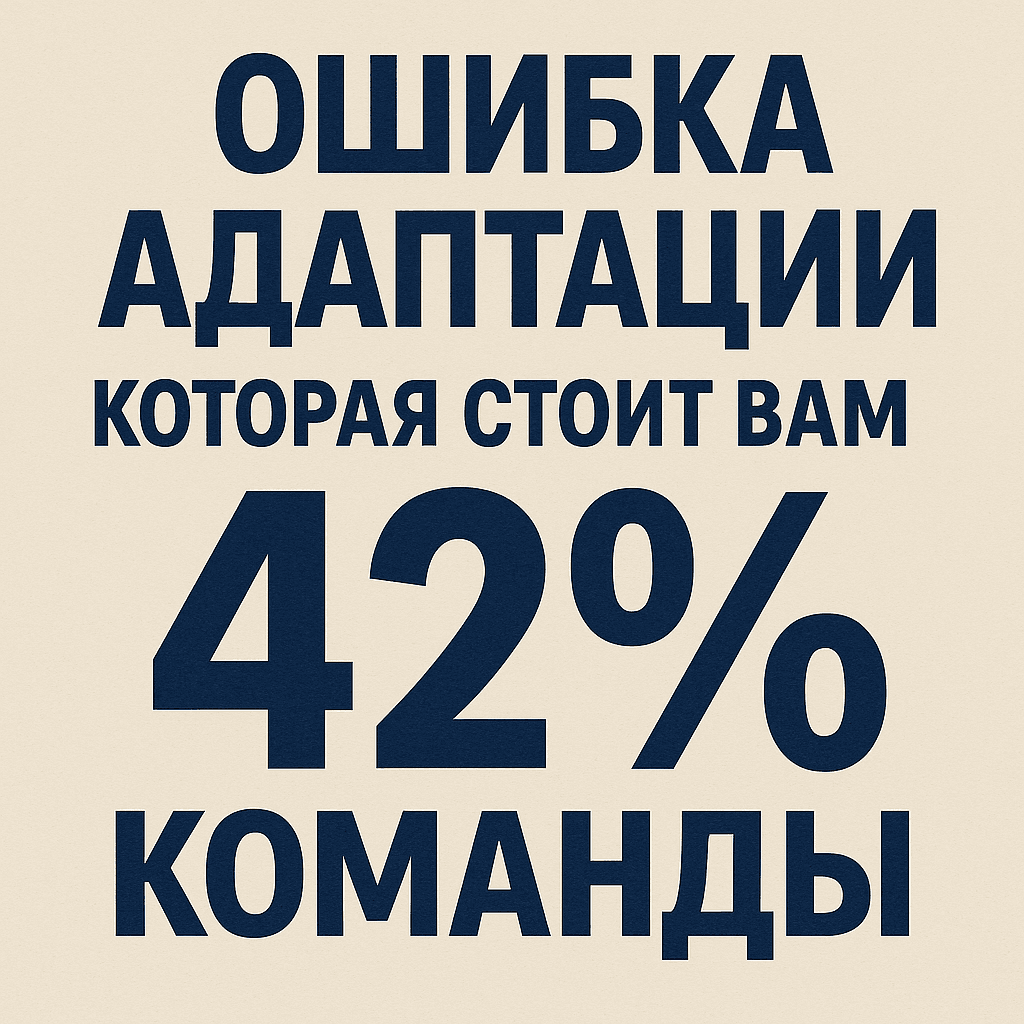
Problem: 42% Leave in the First 90 Days
2013, Yekaterinburg. Our IT company was actively hiring Python/Django developers to expand the team. The market was tight, so we mainly hired junior and middle specialists — those we could afford and who were willing to learn.
Hired in 3 months: 12 people. Left in first 90 days: 5 people (42% early turnover).
Pain point: Every departure of a new employee in the first months means wasted recruiting time, wasted onboarding investment, team demotivation, and reputational damage ("the company everyone runs from").
Why they left:
- "Didn't understand what the company actually does" (expectations didn't match reality)
- "Was left alone to figure out the codebase, did nothing for a month"
- "Unclear who to ask questions, everyone's busy"
- "Tasks were either too simple or impossible for my level"
- "Another company offered more money" (and we didn't have time to show the value of working here)
Root cause: absence of a clear adaptation process. Newcomers "thrown into the water" — sink or swim. This approach only works for the most persistent and independent.
Hypothesis: Structure Beats Chaos
Assumption: if we create a clear onboarding program with mentorship, training sessions, and gradual task complexity, we will:
- Reduce early turnover from 40% to < 20%
- Accelerate time to full productivity
- Improve new employee satisfaction
What we DIDN'T do before:
- ❌ No welcome program for day one
- ❌ No assigned mentors
- ❌ No training plan for first 90 days
- ❌ No regular check-ins with newcomers
- ❌ No gradual task progression
New approach: building a 3-level onboarding program.
Solution: First 2 Weeks Determine Everything
Week 1: Welcome & Foundation
Day 1: First Impression
Before: "Here's your desk, here's your laptop, set it up yourself, ask if you need help."
Now:
09:00 — CEO Welcome Meeting
- About company, mission, clients
- Where we're headed, why it matters
- Q&A
10:00 — Setup Session with Team Lead
- Hardware distribution
- Access (GitLab, Redmine, email, Slack)
- Environment setup instructions
12:00 — Lunch with Team
- Informal introduction
- Icebreaker questions
14:00 — Code Tour
- Project architecture (high-level)
- Where things are, how code is structured
- Coding standards document
16:00 — Buddy Assignment
- Assign someone from team for everyday questions (not mentor!)
- "Where's the cafeteria, how does the office work, who to contact"
Day 1 result: newcomer feels welcome, understands company context, has workspace set up, knows who to ask for help.
Why This Works: Psychology of Onboarding
| What We Do | What Psychological Need It Fulfills |
|---|---|
| CEO Welcome Meeting | Creates feeling of belonging to something important. Fulfills basic need for significance and connection. "They were waiting for me, the CEO told me about the mission — I matter." |
| Buddy Assignment | Reduces cognitive load and social anxiety. Allows asking "stupid questions" (where's the bathroom, how to order a pass) without fear of looking incompetent to mentor. |
| First Bug Fix (Day 2) | Triggers progress effect — the most powerful motivator (Teresa Amabile's research). Feeling "I already did something in 2 days" is critical for confidence. |
| Code Tour | Removes feeling of being overwhelmed by complexity. "The codebase is huge, but they showed me the map — I won't get lost." |
| Gradual Complexity (Bug → Feature → Complex) | Works like a game — you don't start with the final boss. Each completed task = new level, triggering dopamine release and forming attachment to company. |
Key Insight: Day one sets the tone for the entire onboarding. If someone spends 8 hours on day one setting up environment alone — that's a bad start. If they met CEO, team, got access and understood architecture — that's a good start. The difference isn't in the process, but in the emotions that remain.
Days 2-5: Code Immersion
Week task: fix 2-3 simple bugs (good first issues)
Process:
1. Mentor provides link to issue in tracker
2. Newcomer studies code, finds problem
3. Writes fix, makes commit
4. Mentor does detailed code review
5. Newcomer revises code based on feedback
6. Merge to production
Goal: not "complete feature," but learn to navigate codebase, understand code review process, get used to conventions.
Week 1 success metric: newcomer made at least one commit to production and understood workflow.
Week 2: First Real Task
Task: small feature from backlog (4-8 hours work, well-scoped).
Differences from week 1:
- Not a bug, but new functionality
- Requires understanding multiple modules
- Has deadline (but soft)
Support:
- Pair programming with mentor on first day (2-3 hours)
- Daily check-in (15 min at end of day): "How's it going? Where stuck?"
- Code review after each commit (not at end, but ongoing)
Result: by end of week 2, newcomer has first completed feature in production.
Psychology: First shipped feature is a milestone that gives confidence. "I can do useful things here, I contribute" vs "I've done nothing for 2 weeks."
Months 1-3: Systematic Growth
Weekly Training Sessions
Monday — Production Postmortem (30 min):
- Review interesting bug or incident from past week
- What broke, why, how fixed, what learned
- Goal: learn from real examples, not theory
Wednesday — Code Review Workshop (60 min):
- Take 2-3 pull requests from team
- Review together: what's good, what can improve
- Teach juniors to review code (not just write)
- Goal: develop shared understanding of code quality
Friday — Tech Talk (45 min):
- One developer (senior or middle) gives presentation
- Topics: Django ORM deep dive, PostgreSQL indexes, Git advanced, Python decorators
- Internal knowledge base grows
- Goal: knowledge sharing, creating learning culture
Mentorship: Not Leaving Them Alone
Structure:
- Each junior assigned senior mentor
- Weekly 1-on-1 (30 min on Friday)
- Discuss:
- What was difficult this week?
- What did you learn?
- What questions remain?
- Where do you want to grow?
Mentor's responsibilities:
- Ensure newcomer doesn't "get stuck" too long (> 2 hours) — teach to ask for help
- Select tasks of appropriate level (not too simple, not impossible)
- Give constructive code feedback
- Support motivation
Mistake we avoided: Mentor is not "person who does work for newcomer." They're someone who helps learn. If mentor starts writing code instead of newcomer — that's mentorship failure.
Task Gradation: From Simple to Complex
First month:
- Bug fixes (simple)
- Minor UI improvements
- Refactoring small code sections
- Criteria: tasks with clear scope and clear solution
Second month:
- Small features (1-2 days work)
- Modifying existing API endpoints
- Writing tests for legacy code
- Criteria: requires understanding multiple modules, but algorithm clear
Third month:
- New features (3-5 days work)
- API endpoints from scratch
- Performance optimization (under mentor supervision)
- Criteria: independent work with minimal help
Success indicator: by end of month 3, junior can independently take feature from backlog and bring to production.
Results: Numbers and Feedback
Metrics 6 months after program implementation:
Retention
Interpretation:
- Early attrition dropped 3x (from 42% to 14%)
- Those who made it past first 3 months stay long-term (86% through year)
- Hiring ROI sharply increased — less spent on repeat searches
Time to Productivity
Before program: 4-5 months to independent work After program: 2-3 months to independent work
Why accelerated:
- Structured learning instead of chaotic
- Mentorship removes "stuck for a week" situations
- Task gradation builds confidence faster
Satisfaction Score
Surveyed newcomers after 3 months:
| Question | Before Program | With Program |
|---|---|---|
| "I felt welcome on day one" | 3.2 / 5 | 4.7 / 5 |
| "I understood what was expected of me" | 2.8 / 5 | 4.5 / 5 |
| "I had someone to ask for help" | 3.0 / 5 | 4.8 / 5 |
| "I see my progress and growth" | 3.1 / 5 | 4.6 / 5 |
| Overall Satisfaction | 3.0 / 5 | 4.7 / 5 |
Qualitative Feedback
What newcomers said (anonymous surveys):
"On day one they met me, showed me around the office, walked through projects. I immediately felt they were expecting me."
"Mentor helped me not get lost in the codebase. Without them I definitely wouldn't have made it the first month."
"Friday tech talks are fire. I learn so much new every week."
"Code review sessions taught me to look at code differently. Now I understand what 'good code' means."
"I saw my progress: first week — bugs, second — feature, third — already harder. It's motivating."
What DIDN'T Work (Honest About Failures)
❌ Attempt to Create "Perfect Documentation"
Idea: write detailed documentation of all processes so newcomers read and immediately understand everything.
Reality: nobody read 50-page documentation. Even if they did, still asked same questions.
Conclusion: better short cheat sheets and live communication than long manuals.
❌ Mandatory Python/Django Courses
Idea: make all juniors complete online Django courses before starting work.
Reality: courses completed "just to check the box," knowledge not applied because real codebase very different from tutorial examples.
Conclusion: better to teach on real tasks (bug fixes → features) than abstract tutorials.
❌ Too Many Meetings
Idea: daily stand-ups for newcomers to track progress.
Reality: newcomers need more time for coding, not meetings. Stand-ups demotivated ("I did nothing again today").
Conclusion: enough to have weekly 1-on-1 with mentor. Daily check-in only if newcomer stuck.
Onboarding in the AI Era: What Changed and What's Eternal
In 12 years between 2013 and 2025, tools changed but psychology didn't. Newcomers still need structure, belonging, and visible progress. But there are nuances.
AI — Not a Panacea, But a Tool (That Can Harm)
Risk: Newcomer uses ChatGPT/Copilot for tasks without understanding context, creating silent technical debt. Code works but architecturally breaks project concepts.
2024 Example:
Junior asked ChatGPT to generate Django view. AI gave working code but used deprecated function-based view instead of project's class-based views. Code passed tests but created inconsistency.
Solution: Include "AI Usage Rules" in onboarding:
- ✅ Use AI to learn concepts ("Explain how Django middleware works")
- ✅ Generate boilerplate (tests, docstrings)
- ❌ Copy code from AI without understanding project architecture
- ⚠️ All AI-generated code gets enhanced code review with explanation "why this way"
AI Paradox in Onboarding: AI speeds up code writing but slows learning if newcomer doesn't understand what they're copying. Mentor needs to ensure AI is learning aid, not thinking replacement.
Remote-First — It's a Different Philosophy
Problem: "Async-first" onboarding for newcomer = loneliness.
Remote work became norm, but adapting onboarding to it doesn't mean simply "replacing meetings with Zoom."
Principle: First 3 days of newcomer should be maximally synchronous.
Why? Because in async environment:
- Newcomer hesitates to ask questions in Slack ("don't want to disturb")
- Context is lost ("I wrote question 4 hours ago, now it's irrelevant")
- No team feeling (you're alone at home in front of screen)
Adapted structure for remote:
Days 1-3 (maximum synchronicity):
09:00 — Zoom: Welcome call with CEO + team (live!)
10:00 — Zoom: Setup session with mentor (screen sharing for setup)
12:00 — Zoom: Virtual lunch with team (informal introduction)
14:00 — Zoom: Code walkthrough (live, can ask questions)
16:00 — Slack: Buddy assignment + quick check-in
Days 4-14 (transition to hybrid):
- 2-3 synchronous Zoom sessions per week
- Rest async via Slack/Notion
- But mentor **online same hours** as newcomer (overlap)
Months 1-3 (async-first, but with safety net):
- Weekly Zoom 1-on-1 (mandatory!)
- Daily async check-in in Slack
- Monthly team meetings (not about code, about team building)
Key difference: create "presence" effect first days, then transition to async. Reverse order kills retention.
Data-Driven Onboarding: Metrics That Matter
In 2013 we counted "left/stayed." In 2025 we can (and should) be more precise.
Onboarding success metrics:
| Metric | Target | What It Measures |
|---|---|---|
| Time to First Commit | < 4 hours | Environment setup speed + workflow understanding |
| Time to First Meaningful PR | < 5 days | Readiness to work on real tasks |
| Mentor Satisfaction Score | 4+ / 5 | Newcomer progress through mentor's eyes (weekly survey) |
| Onboarding NPS (after 30 days) | 8+ / 10 | "Would you recommend onboarding to a friend?" |
| Task Completion Rate | > 80% | Percentage of completed tasks in first 90 days |
| Code Review Cycles | < 3 iterations | Code quality (fewer iterations = faster learning) |
How to track:
- Jira/Linear: custom fields for onboarding tasks
- GitHub: labels "onboarding", "good-first-issue"
- Google Forms: weekly mentor survey (2 minutes)
- Slack bot: automatic daily check-in ("How's it going? 1-5")
Why metrics? Not for micromanagement, but for early problem detection. If newcomer on week 2 hasn't made commit yet — that's a red flag. Can intervene BEFORE they quit.
What remained unchanged:
- Newcomers need structure and support (doesn't matter office or remote)
- Mentorship works better than any documentation (even Notion knowledge bases)
- First weeks determine retention (psychology doesn't change)
- Gradual complexity builds confidence (game mechanics always work)
Key Takeaways
1. First 2 Weeks Are Critical
If after 2 weeks newcomer:
- ✅ Made at least 1 commit to production
- ✅ Knows who to ask for help
- ✅ Understands codebase structure
- ✅ Feels part of team
...probability of leaving in first 90 days drops dramatically.
2. Mentorship > Documentation
No documentation replaces live person who answers questions, shows how, encourages when difficult.
3. Structure Gives Confidence
When newcomer knows:
- Week 1: bug fixes
- Week 2: first feature
- Month 1: simple tasks
- Month 2: medium complexity
- Month 3: independent work
...they see clear path and understand their progress.
4. Onboarding Is Investment That Pays Off
Cost of bad onboarding:
- Wasted recruiter time (3-4 weeks per hire)
- Lost productivity (newcomer did nothing for month)
- Team demotivation (another new person left)
- Reputational risks (negative reviews on job sites)
Cost of good onboarding:
- 2-3 hours per week of mentor time
- 2-3 hours per week for training sessions
ROI: reducing early attrition from 40% to 14%, program pays for itself in first 3 months.
Checklist: Launch Onboarding in 60 Minutes
Don't have 3 months to build perfect program? Do it in a day. Here's your first onboarding plan for next week:
60 Minutes Before Newcomer Arrives:
- Assign buddy (not mentor!) — someone from team to show "where's cafeteria and how office works"
- 15-minute briefing with buddy: "Ivan's coming tomorrow, show him around, introduce to team"
- Create "Good First Issues" list in task tracker: 3-5 simple bugs newcomer can fix
- Schedule welcome call with leader (CEO/CTO/team lead) — 15 minutes enough
- Prepare hardware (if office) or send shipping info (if remote)
Newcomer's First Day:
- 09:00 — Welcome call (15 min): "We're glad you're here. Here's our mission and where we're going"
- 10:00 — Setup session (60 min): help with environment setup, access distribution
- 12:00 — Lunch with team (informal introduction, icebreaker questions)
- 14:00 — Code walkthrough (45 min): show architecture, where things are, coding standards
- 15:00 — Buddy introduction (30 min): "Here's your buddy, ask them anything"
- 16:00 — First task (rest of day): "Pick one bug from Good First Issues list and try to fix"
End of First Week:
- 30-minute meeting team lead/mentor with newcomer:
- What worked?
- What was unclear?
- What did you learn?
- What questions remain?
- Give feedback on first commit (even if not merged)
- Assign task for week 2 (small feature, 1-2 days work)
That's it. You're already 80% of the way from chaos to system.
These simple steps require no budget, no HR systems, no complex processes. Only intention to show newcomer they were expected.
The Main Message
The most expensive talent is the one you've already hired. Their departure in first 90 days isn't recruiting mistake, it's diagnosis of your internal culture.
Structured onboarding isn't about documents and processes. It's fastest way to show person: "We were waiting for you. We believe in you. You're already part of the team."
In 2013 we learned this with Python developers in Yekaterinburg. Today these principles work for remote teams, designers, marketers, and product managers worldwide.
Because the need to be valued and see your growth — is universal.
Yesterday at HR conference I heard: "Young people don't want to work." Today I wrote this article to show: it's not about young people.
It's about us. More precisely — about you.
Are you willing to spend 60 minutes on next newcomer to avoid spending 3 months searching for the next one?
The checklist above isn't theory. It's action plan for tomorrow. Literally tomorrow, if you have someone new joining next week.
Choose buddy from team. Create 3 simple tasks. Schedule 15-minute CEO meeting. That's all — you're already on path to newcomer staying instead of leaving in a month thinking "not my thing."
Applicable for:
- IT companies hiring junior/middle specialists
- Remote-first teams (with format adaptation)
- Startups building processes from scratch
- Any teams with turnover > 30% in first 90 days
- HR and team leads tired of revolving door
Not applicable for:
- Companies where "newcomers should figure it out themselves" is ideology
- Micromanagement masquerading as "care"
- Toxic cultures (no onboarding compensates for toxicity)