Context
There are moments when anxiety about money outweighs all that vaunted "positivity." When the question spinning in your head is: "Where do I find strength of spirit when my wallet is empty?" And so I imagined a conversation with someone whose psychological type resonates with me — Jack London. A writer who went through poverty, gold fields, and hunger before becoming a classic author.
This is not a real letter, but an exercise in honesty with oneself. Sometimes it helps to talk with someone who has already been through rock bottom and returned with stories about wolves.
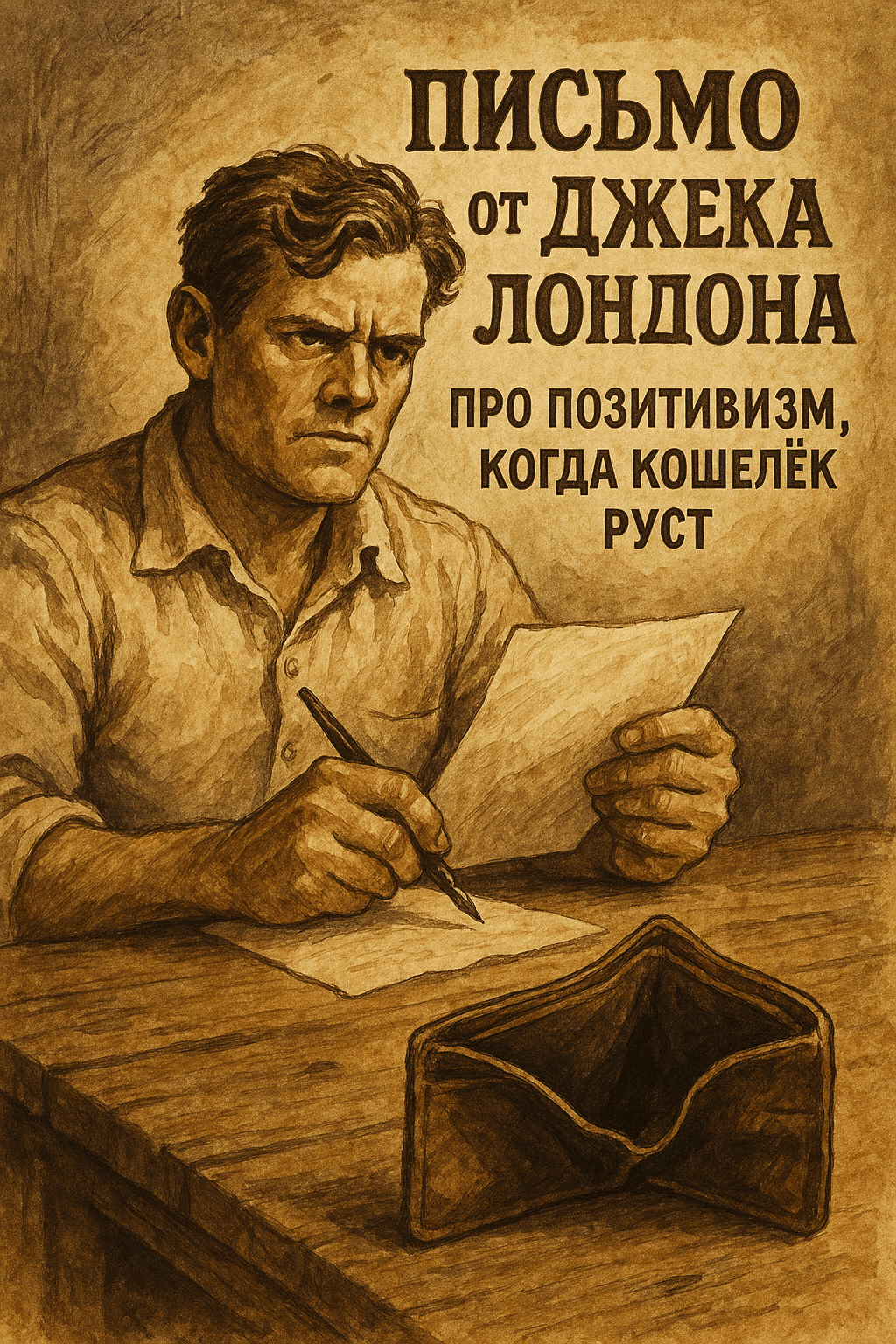
A Letter from Jack London
"Damn it, friend, you ask where positivity is when your wallet is empty? That's the very root of the dilemma!
Listen to me. I wrote about strength of spirit, about the will to live, about man's triumph over nature. But I know what I'm writing about. I grew up in poverty myself. I was an 'oyster pirate,' a vagabond, a gold prospector. I truly starved, not metaphorically, but in a way that twisted my gut.
Nerves in such moments — that's not weakness. That's animal instinct. That's the very call of the wild whispering to you: 'Survive!'
You're nervous because money isn't just paper. In our world, in this steel cage of civilization, money is firewood for your bonfire on a snowy night. It's ammunition in your Winchester against a hungry wolf pack. It's your ticket on that very ship that sails away from the dreary shores of 'everyday life.'
Your positivity — it's not about smiling at an empty pocket. That's idiocy. Jack London's positivity is a snarl. It's clenching your fists, spitting on your palms, and saying: 'Alright, the game has begun.'
Your nervousness is fuel. It's that very energy that made my heroes go forward when others gave up.
So where is your positivity? It's in action."
Four Steps from Panic to Action
London is right: positivity is not an emotion, but an action. Here's what helps switch from anxiety to problem-solving:
1. Look the Beast in the Face
Acknowledge the fact: yes, without money I'm vulnerable. This is reality, like fifty-below frost. The strong look facts in the face, the weak hide from them.
Don't run from the problem into illusions or self-deception. Honesty with yourself is the first step toward a solution.
2. Make a Plan, as for an Expedition
You're not just "looking for work" — you're charting a route to a new gold vein. You're not "economizing" — you're rationing provisions for a long journey. Turn the problem into a task.
Practice:
- Describe the situation as a task: "I need X amount in Y days"
- Make a list of actions that bring you closer to the goal
- Mark each step — this reduces anxiety and gives a sense of progress
3. Rely on Your Tribe
Remember "Hearts of Three." No hero survived alone. Ask for help, offer something in return. Strength is in fellowship.
Asking for help is not weakness. It's a sign of strength and common sense. People are willing to help if you're specific and honest.
4. Remind Yourself Who You Are
You are a descendant of those who survived the Ice Age, crossed oceans, and conquered continents. That tremor in your hands is ancient code, not a sign of defeat. It's readiness for battle.
What This Means in Practice
In moments when money runs out and nerves are frayed, I try to remember:
Nervousness is not the enemy. It's the body's signal: "Act!" The problem isn't the nerves themselves, but where I direct that energy. You can get stuck in panic, or you can transform it into concrete steps.
Positivity without action is useless. Smiling at an empty wallet is not strength of spirit, but an escape from reality. Real positivity is when you acknowledge the problem and go solve it, even if you're scared.
Nothing comes for free. Even if you have character traits — will, resilience, optimism — they need to be hardened. Like muscles: if you don't load them, they atrophy.
Conclusion
Strength of spirit is not an innate quality. It's a muscle that's built through experience, through pain, through choosing to "keep going" at the moment when you want to give up.
Jack London wrote about wolves and gold prospectors not because it was a beautiful metaphor. He wrote about what he himself experienced. And the main lesson of his stories is not that "the strong survive," but that people become strong.
So I don't blame myself for nerves. I embrace them. This is my Wolf Larsen, my Smoke Bellew, my Martin Eden, who rebels against humiliating circumstances.
And then I direct that energy and go write my chapter. Let it be harsh, vivid, and victorious. I act as if my life depends on it.
Because it does.
Recommended Reading for Inspiration:
- Jack London — "Martin Eden" (about will and self-determination)
- Jack London — "The Call of the Wild" (about returning to your true self)
- Viktor Frankl — "Man's Search for Meaning" (about choosing meaning in any circumstances)